Double Oven Owner’s Guide: Practical Help For Everyday Cooking
Quick start you can finish fast
Your Double Oven looks impressive, but it doesn’t need to be intimidating. Here’s how to get from box to dinner without drama.
- Remove all packaging, tape, and cardboard from inside both cavities and around the doors.
- Take out racks, trays, and any included accessories and wash them in warm, soapy water, then dry thoroughly.
- Wipe the inside of each oven with a damp cloth or sponge; dry with a soft towel.
- Make sure the Double Oven is level and has good airflow around it (especially at the back and top).
Before you cook food, it helps to do a short “empty” burn-in to clear factory residues.
- Set both ovens to bake around 375–400°F.
- Run for about 30–45 minutes with the kitchen ventilated (window open or hood on).
- Let the Double Oven cool completely with doors closed before your first meal.
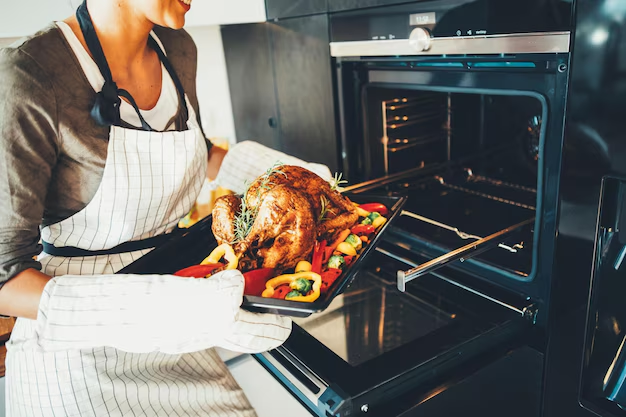
Simple first-use example: roasting chicken pieces
This is a good first “real” test because it’s forgiving and uses both heat and time clearly.
- Place chicken pieces on a rimmed pan in the lower oven.
- Set the lower oven to bake at 375–400°F for about 30–45 minutes, depending on size.
- Use the upper oven at the same time for something simple like roasting vegetables at 375–400°F for 15–30 minutes.
- Chicken is done when juices run clear and the thickest part is cooked through; vegetables should be tender with light browning at the edges.
Know your parts without guessing
Most units have
- Upper oven cavity – Often used for smaller dishes, quick bakes, or broiling. Heats up faster because it’s smaller.
- Lower oven cavity – Typically larger; better for roasts, big casseroles, and baking sheets.
- Oven racks – Removable metal racks that can be placed at different levels to control browning and distance from the heat.
- Interior light – Lets you check food without opening the door and dropping the temperature.
- Control panel – Knobs, buttons, or a touch panel to set temperature, mode (bake, broil, convection if present), and timers.
- Door seals (gaskets) – Flexible seals around each door that keep heat in and improve efficiency.
- Door glass – Multi-layer glass window so you can see inside; also helps insulate the Double Oven.
- Heating elements – Usually one at the top (for broiling/browning) and one at the bottom (for baking) in each cavity.
Some units have
- Convection fan – Circulates hot air for more even baking and faster roasting when a convection mode is selected.
- Self-clean function – High-heat or steam-clean cycle that breaks down baked-on residue inside the cavity.
- Telescopic racks – Racks that slide out smoothly on rails so you can check heavy dishes more easily.
- Meat probe – A temperature probe that plugs into the Double Oven and reads the internal temperature of roasts.
- Control lock feature – Disables the controls to prevent accidental operation or changes.
- Keep-warm mode – Holds food at a low temperature after cooking, without aggressively continuing to cook it.
Safety that actually prevents problems
- Keep flammable items away from the cooktop and the face of the Double Oven; no dish towels or paper on or against hot surfaces.
- Use cookware rated for oven temperatures; plastic lids and some glass can warp or shatter under high heat.
- Open doors slowly and stand slightly to the side to avoid a blast of very hot air.
- Do not use foil directly on the oven floor; it can block airflow, damage the finish, and affect temperature readings.
- Place heavy dishes on racks fully pulled out and supported; don’t balance pans on a half-extended rack.
- Check that racks are fully seated before loading; a tilted rack is a spill waiting to happen.
- Keep door seals clean and intact; damaged seals leak heat and can cause poor performance.
- Use both hands for heavy or awkward pans, especially when reaching into the lower oven.
- Unplug or switch off at the breaker before working around internal wiring or replacing certain internal components.
- Let your Double Oven fully cool before wiping inside with anything wet to avoid steam bursts and possible cracking of very hot glass or enamel.
- Ventilate your kitchen when using self-clean functions or high-heat roasting to reduce smoke and odors.
Daily use for better results
Think of your Double Oven as two tools sharing one frame. Use each cavity for what it’s best at.
- Choose the cavity: use the smaller/upper oven for quick or single-tray jobs; use the larger/lower oven for big roasts or several trays.
- Adjust racks before preheating so you’re not handling hot metal later.
- Preheat to your target temperature; most baking benefits from a full preheat of about 10–15 minutes.
- If you have convection, use it for roasting meats and vegetables or baking multiple trays; stick to regular bake for delicate cakes unless you know how they behave.
- Stagger cooking: for example, roast potatoes in the lower oven while baking dessert in the upper oven at a slightly different temperature.
- Avoid opening the doors repeatedly; rely on the window and lights whenever possible.
- Rotate pans halfway through for more even results, especially when baking cookies or sheets of vegetables.
- After cooking, turn off each oven separately and crack a door slightly if you want a gentle cool-down and to reduce lingering moisture.
| Food / Task | Suggested cavity & settings | Doneness cues | Common mistakes |
|---|---|---|---|
| Sheet pan cookies | Upper oven, bake at 325–350°F; single tray at a time | Edges just set and lightly golden; centers still soft | Using both ovens with too many trays at once, leading to uneven baking |
| Roast chicken (whole) | Lower oven, roast at 350–400°F; use convection if available | Skin browned; juices clear when pierced at thigh | Placing bird too high so top browns before inside is cooked |
| Lasagna or casserole | Lower or upper oven, bake at 350–375°F with rack in center | Bubbling at edges; center hot and set | Packing both ovens so full that airflow is blocked |
| Frozen pizza | Upper oven, bake at 400–450°F on middle rack | Cheese melted and browned; crust crisp underneath | Using a pan instead of placing directly on rack, making crust soggy |
| Broiled steaks or fish | Upper oven, broil with rack in upper-third position | Surface well-browned; interior at preferred doneness | Placing food too close to broil element and burning the top |
| Roasted vegetables | Either oven, bake/roast at 400–425°F; convection helpful | Edges caramelized; fork-tender inside | Crowding pans so vegetables steam instead of brown |
| Quick reheat of leftovers | Upper oven, 275–325°F; loosely covered | Food hot throughout but not dried out | Using broil for reheating, which often scorches the top |
Cleaning and maintenance that doesn’t ruin parts
After each use
- Once the Double Oven is warm but not hot, wipe spills on the door and near the front of the cavity with a damp cloth.
- Brush crumbs off racks and the oven floor with a soft brush or cloth.
- For light grease splatters, use a mild dish soap solution; dry surfaces afterward.
Weekly or regular light cleaning
- Remove racks and wash them in warm, soapy water; avoid heavy scouring pads that scratch.
- Wipe the interior with a non-abrasive sponge and a gentle cleaner suitable for enamel surfaces.
- Clean the door glass with a soft cloth and glass-safe cleaner, avoiding contact with door seals.
- Gently wipe the control panel with a damp cloth; do not spray cleaner directly onto electronic controls.
When it smells weird or performs poorly
- Look for burnt-on spills on the oven floor or walls; these cause smoke and odors and can affect heating.
- If your Double Oven has a self-clean or steam-clean feature, use it according to the settings, after removing racks and accessories that are not rated for self-clean cycles.
- Inspect door seals; baked-on grease here can stop the door from closing tightly and cause heat loss.
- Check that vents and fan inlets (if you have convection) are not blocked with foil, pans, or debris.
What not to do
- Do not use metal scrapers or steel wool on enamel, glass, or coated racks; they can permanently scratch surfaces.
- Avoid harsh oven cleaners on self-cleaning interiors unless they are explicitly labeled as safe for that surface.
- Do not line the oven floor with foil or silicone mats that cover it completely; this can trap heat and damage the finish.
- Do not remove door seals or inner glass panels unless the manufacturer specifically allows and explains how.
- Avoid soaking racks with ball-bearing slides or telescoping systems for long periods; wipe and dry them thoroughly instead.
Two common maintenance complaints: quick checklists
Complaint: “My Double Oven smokes every time I turn it on.”
- Check for old spills or grease on the floor and around the edges; scrape gently with a plastic tool if needed.
- Run the oven empty at about 400°F for 20–30 minutes with a window open to burn off remaining residue.
- Use a deeper pan or a baking sheet under bubbly dishes next time to catch drips.
Complaint: “The top and bottom ovens seem to cook differently.”
- Place an oven thermometer in each cavity and preheat both to the same temperature to see how they compare.
- Adjust recipes slightly: use the hotter cavity for roasting and the more accurate cavity for delicate baking.
- Keep records: if you consistently need to reduce temperature by about 25°F in the upper oven, treat that as your “house rule.”
Troubleshooting that gets you unstuck fast
Use this section when your Double Oven is acting stubborn. Match what you see to the symptom and follow the likely cause and fix.
| Symptom | Likely cause | Fix |
|---|---|---|
| Double Oven will not turn on at all | No power or tripped breaker | Check the outlet or breaker panel and restore power; make sure any wall switch that controls the outlet is on. |
| One cavity heats, the other stays cold | Separate control or element issue; settings not correctly selected | Confirm the correct oven is selected on the control panel and set to a heating mode; if still cold, it likely needs professional service. |
| Oven light works, but no heat | Heating elements disabled, mode set to “off,” or safety lock active | Verify bake or broil mode is selected and temperature set; check for a control lock icon and disable it as instructed by the panel prompts. |
| Food burns on top, raw in middle | Rack too high or broil/too-high setting | Lower the rack one or two positions, reduce temperature by about 25°F, and avoid placing food too close to the top element. |
| Food undercooked, even after long time | Temperature running low or door frequently opened | Use an oven thermometer to check actual temperature; avoid opening the door often; increase set temperature slightly if readings are low. |
| Uneven browning between front and back | Hot spots and limited air circulation | Rotate the pan halfway through cooking and leave at least a few inches of space around cookware for airflow. |
| Digital display on but controls unresponsive | Control lock engaged or temporary electronic glitch | Look for a lock icon and follow the on-panel instructions to unlock; if still stuck, turn power off at the breaker for a minute, then restore. |
| Oven door will not close fully | Rack or pan blocking, or dirty/damaged door seal | Remove everything and try closing the empty door; clean the gasket gently; if the seal is torn or deformed, schedule service. |
| Oven makes a whirring or fan noise | Cooling or convection fan running | This is usually normal; the fan may run after the oven is turned off. If the noise becomes loud or grinding, have it checked. |
| Clock or display resets randomly | Power fluctuations or loose connection | Check for other appliances blinking; consider using a surge protector if appropriate; if only the Double Oven is affected, consult service. |
| Smoke or strong burning smell during normal baking | Old spills or food debris burning | Let the oven cool and clean visible residue; do a short high-heat burn-off with ventilation before your next critical bake. |
| Self-clean cycle will not start | Door not fully latched or temperature too high from recent use | Allow the Double Oven to cool completely, remove racks if required, ensure the door closes securely, then try again. |
Mini decision path: If your Double Oven will not start heating
- Check if any lights or display are on.
- If completely dark, confirm power at the outlet or breaker.
- If the display is on, continue.
- Look for a control lock icon or message.
- If locked, follow the on-panel prompt to unlock (often a long press on a specific button).
- If not locked, continue.
- Verify you have actually selected a heating mode (like bake) and set a temperature above room temperature.
- Try the other cavity to see if either will heat.
- If one works and the other does not, or neither heats despite correct settings and power, stop and arrange professional service.
When to stop and get service
There are times when DIY should give way to a trained technician. Here’s when to pause.
- Persistent tripping of breakers whenever the Double Oven is used.
- Visible damage to the power cord, plug, or wiring.
- Sparks inside the oven that are not from accidental foil contact with elements.
- Cracked or shattered door glass on either cavity.
- Strong burning smell with no visible food residue and no improvement after a cleaning cycle.
- Doors that will not latch or stay closed, even when empty and clean.
- Controls that behave unpredictably, such as changing settings on their own.
- Any sign of melting, deformation, or discoloration around vents, seals, or trims.
Smart habits that save time
- Keep the most-used racks at your usual baking positions so you do not have to rearrange them every time.
- Assign “jobs” to each cavity: for example, upper oven for everyday single dishes, lower oven for big-batch or weekend baking.
- Use shallow pans for roasting to encourage browning; deep covered dishes are better for braising and stews.
- Group similar-temperature dishes when planning meals so you can share a cavity or run both ovens without extreme temperature jumps.
- Use oven-safe liners only on racks or pans, never directly on the oven floor.
- Store only oven-safe items inside when not in use; remove plastic containers, cutting boards, or extra pans before turning the Double Oven on.
- Wipe small spills quickly; they are far easier to remove when fresh than after a few high-heat cycles.
Quick FAQ
Can I run both ovens in my Double Oven at the same time?
Yes, that is a main reason to own a Double Oven. Just remember that long, heavy use of both cavities can slightly change how evenly each one heats, so check food a bit earlier until you know your unit’s behavior.
Which cavity should I use for everyday cooking?
Most people use the smaller or upper oven for quick meals and the larger or lower oven for big pans, roasts, and multi-tray baking. Choose based on size and how quickly you want it to preheat.
Is convection always better?
Convection is great for roasting and for multiple trays because it promotes even browning. For delicate cakes, custards, and soufflés, regular bake is often more predictable.
Do I need to preheat my Double Oven every time?
Preheating is important for most baking and roasting. For simple reheating or warming bread, you can often skip a full preheat and just add a few extra minutes.
Can I use foil in the Double Oven?
You can use foil on pans or lightly tented over dishes, but avoid lining the oven floor or fully covering racks, which can trap heat and affect performance.
Why does my Double Oven fan run after I turn it off?
Many units use a cooling fan that continues running to protect internal components and gradually reduce temperature. This is normal and should stop on its own.
How often should I use the self-clean function?
Use self-clean or steam-clean only when regular wiping no longer keeps the interior reasonable, not after every small spill. Frequent high-heat cleaning can stress components, so focus on spot cleaning first.
Can I leave racks in during self-clean?
Some racks can stay; others can discolor or warp. If in doubt, remove racks and clean them separately with warm soapy water and a non-abrasive pad.
Why is there a slight odor the first few times I use my Double Oven?
New insulation and coatings can give off an odor during the first several heat cycles. A thorough empty burn-in with good ventilation usually clears it.
Is it normal for one oven to heat a little differently than the other?
Yes, small differences are common. Use an oven thermometer to learn each cavity’s “personality,” then adjust temperatures or rack positions accordingly.
Can I dry dishes or towels in the Double Oven?
It is not recommended. The temperatures are not controlled in a way that is ideal for drying fabrics or plastics, and it wastes energy compared with air-drying.
How long should my Double Oven last?
With regular cleaning, gentle use of surfaces, and prompt attention to odd noises or door issues, many Double Ovens serve well for well over a decade.
Discover More
- Air Conditioner
- Air Fryer
- Air Purifier
- Automatic Soap Dispenser
- Barbecue Grill
- Beverage Cooler
- Beverage Dispenser
- Beverage Fridge
- Blender
- Boiler
- Bread Maker
- Bread Slicer
- Bread Toaster Oven
- Can Opener
- Carpet Cleaner
- Ceiling Fan
- Ceiling Heater
- Ceiling Mounted Heater
- Ceiling Mounted Vent Fan
- Central Vacuum
- Charcoal Grill
- Citrus Juicer
- Clothes Dryer
- Clothes Steamer
- Coffee Grinder
