Tankless Water Heater Home Manual & Help Guide
Quick start you can finish fast
Your Tankless Water Heater is basically a hot water tap on demand, with opinions. Let’s get it on your side quickly.
- Unpack the unit and remove all plastic bags, foam, and manuals from around the Tankless Water Heater.
- Check for visible damage to the case, piping connections, power cord, or vent connections if present.
- Confirm the correct fuel and power:
- For gas units: gas shutoff valve reachable, gas line sized correctly, and proper ventilation path.
- For electric units: dedicated circuit, correct voltage, and breaker rating as labeled on the unit.
- Ensure cold water inlet and hot water outlet are correctly connected and secured with shutoff valves.
- Open the cold water supply valve and a nearby hot water faucet to purge air until water runs smoothly, then close the faucet.
- Power on the Tankless Water Heater using its main power switch or control panel.
Many units require a brief first run to flush the heat exchanger.
- Set the temperature to around 120–125°F (49–52°C).
- Open a hot water tap fully for about 5–10 minutes to flush the system.
- Check for leaks around all visible connections during this flush.
First-use example: Hot shower setup
Once flushed and leak-free, you can dial it in for everyday comfort.
- Set the Tankless Water Heater temperature to about 115–120°F (46–49°C) for comfortable showers.
- Open the shower hot tap fully, then slowly add cold water if needed for fine-tuning.
- Allow a short delay after adjustments; water temperature often stabilizes in about 10–20 seconds.
Know your parts without guessing
Most units have
- Cold water inlet – Where cold water enters the Tankless Water Heater. Usually marked blue or “IN.”
- Hot water outlet – Sends heated water to your fixtures. Usually marked red or “OUT.”
- Gas connection or power terminals – Supplies energy to the heater:
- Gas units: threaded gas nipple or flex connector.
- Electric units: internal terminals or a power cord.
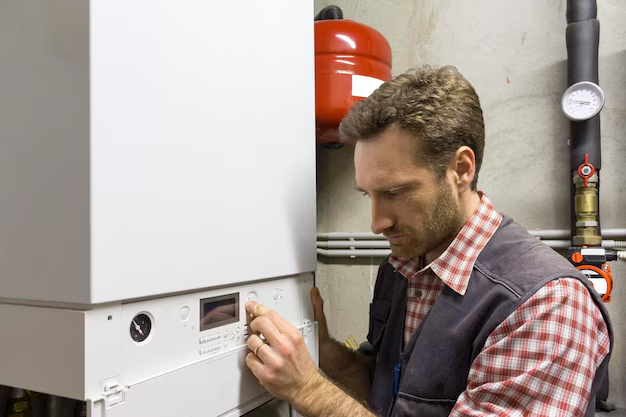
- Control panel or display – Lets you set temperature, view error codes, and sometimes flow or status icons.
- Main power switch – Turns the unit on or off without cutting circuit breakers or gas valves.
- Heat exchanger – Internal metal coil or block where water is heated as it flows through.
- Burner or heating elements – The actual heat source: flame for gas, electrical elements for electric models.
- Temperature sensors – Monitor incoming and outgoing water temperature for accurate control.
- Flow sensor – Detects water flow so the Tankless Water Heater knows when to start heating.
- Pressure relief valve connection – Safety outlet that allows excess pressure to vent safely to a drain line.
Some units have
- Remote controller – Wall-mounted control that mirrors the main display for easier access near bathrooms or kitchens.
- Recirculation connection or pump – Lets the system keep hot water moving in a loop so you get hot water faster at distant taps.
- Condensate drain – On high-efficiency units, removes condensate water from the venting path.
- Freeze protection – Internal heaters or controls that help protect the unit in cold climates when powered.
- Service valves (isolation valves) – Special valves with ports in the hot and cold lines for easy descaling and flushing.
- Filter or inlet screen – Small mesh filter on the cold inlet that catches debris and sediment.
- Combustion air intake and vent collar – For direct-vent gas units, where outside air enters and exhaust gases exit.
Safety that actually prevents problems
- Set a safe temperature: Keeping the Tankless Water Heater around 120°F (49°C) helps reduce scald risk while still being hot enough for most uses.
- Always keep vents and combustion air openings clear so gas units burn cleanly and exhaust properly.
- Do not store flammable products near the Tankless Water Heater, especially around gas models and vents.
- Never cap or block the pressure relief valve; it must be free to discharge into an appropriate drain path.
- Avoid opening the unit’s internal panels unless power and gas are off; internal wiring, burners, and elements are not user-serviceable.
- Use only potable water; untreated well water with high sediment or minerals should be filtered to protect the heat exchanger.
- Do not operate the Tankless Water Heater without water flowing; running “dry” can damage the heat exchanger quickly.
- Protect outdoor or garage installs from freezing with insulation, heat tape, or built-in freeze protection kept powered.
- If you ever smell gas or see scorch marks, stop use immediately and keep the unit off until checked by a qualified technician.
- Never bypass safety devices such as flow sensors, temperature sensors, or high-limit cutoffs.
Daily use for better results
Once installed, the Tankless Water Heater becomes part of your daily rhythm. Here’s how to keep it predictable.
- Set your preferred base temperature on the control panel, typically in the 115–125°F (46–52°C) range for whole-house use.
- For most taps, open the hot handle fully first, wait a short moment for temperature to stabilize, then blend in cold if needed.
- Avoid turning hot water to a trickle; many Tankless Water Heater units need a minimum flow (often around 0.4–0.6 gallons per minute) to stay on.
- Try not to change temperature on the unit constantly for different tasks. Use one “house” setting and adjust at the faucet.
- Stagger big hot water demands where possible; for example, avoid running the dishwasher, washing machine, and showering all at once on a small unit.
- If a shower runs cooler during another tap’s use, reduce one fixture slightly rather than cranking up the water heater temperature.
- Listen and glance at the display occasionally:
- Unexpected noises or sudden error codes are your early warning system.
| Common use | Suggested temperature / flow habit | Finish / comfort cue | Common mistake |
|---|---|---|---|
| Everyday shower | Set Tankless Water Heater to 115–120°F; open hot fully, then blend cold | Stable, comfortable temperature without constant mixing | Setting unit to very high temp and mixing a lot of cold, which increases scald risk and temperature swings |
| Hand washing | Same 115–120°F setting; moderate flow for quick activation | Warm water arrives within a short delay, stays steady | Using a tiny trickle that shuts the burner or elements off repeatedly |
| Dishwashing by hand | 120–125°F for greasy dishes; full flow at sink | Water hot enough to cut grease without constant adjusting | Flipping hot on and off rapidly, causing inconsistent temperature |
| Bath filling | Hot tap fully open; adjust with a bit of cold as tub fills | Tub fills with consistent hot water, no sudden cooling halfway | Low-flow fill that drops below activation threshold so water cools suddenly |
| Laundry with hot fill | House setting 120°F; washer on “hot” or “warm” as desired | Washer fills with stable temperature water | Running washer, shower, and kitchen sink hot at the same time on a small unit |
| Kitchen sink quick rinse | Open hot fully for a short burst, then close | Hot water arrives quickly for rinsing | Feather-light trickle the heater can’t “see,” leaving you with cold only |
Cleaning and maintenance that doesn’t ruin parts
After each day of use
- Take a quick look at the display for any warnings or error indications before you ignore them for weeks.
- Visually check under and around the Tankless Water Heater for signs of leaks or drips.
- For outdoor units, ensure no debris, leaves, or snow is blocking the intake or exhaust.
Weekly or monthly habits
- Dust the exterior gently with a dry cloth so vents and intake areas stay clear.
- Confirm that vent terminations outside stay unobstructed and intact.
- Glance at the pressure relief valve discharge line; it should be dry and not capped.
- Check the area around the unit for any new water stains or corrosion on pipes and fittings.
Deeper maintenance: when it smells weird or performs poorly
If hot water output drops, water becomes inconsistent, or there’s a metallic or “burnt” smell, the system may need descaling or internal cleaning.
- Use the built-in service valves, if present, to flush the heat exchanger with a descaling solution made for Tankless Water Heater units.
- Typical descaling uses a pump, hoses, and a bucket with about 3–4 gallons of descaling liquid circulated for around 30–60 minutes.
- After descaling, flush thoroughly with clean water until any odor from the solution is gone.
- Clean the cold inlet screen or filter if accessible:
- Shut off water and power first.
- Remove the screen, rinse debris, and reinstall carefully.
What not to do
- Do not use harsh abrasives, steel wool, or solvents on the exterior or any plastic parts.
- Do not open sealed combustion chambers or modify venting yourself; this can affect safety and performance.
- Do not bypass descaling by using random household acids; use solutions designed for heat exchangers.
- Avoid spraying water directly into vents, around gas valves, or onto electrical connections.
- Do not insulate directly over the unit’s body or vents; insulate around pipes only as recommended.
Two common maintenance complaints and quick checklists
Complaint: “My hot water keeps cutting out.”
- Check for low flow:
- Are faucet aerators or showerheads clogged and causing a trickle?
- Try increasing flow to see if the burner or elements stay on.
- Look for sediment or scale:
- Has the Tankless Water Heater been descaled in the last 12–24 months in hard water areas?
- If not, schedule a descaling.
- Verify temperature setting:
- Extremely high setpoints can trigger safety limits and cause shutdowns.
Complaint: “The water is not as hot as it used to be.”
- Confirm the set temperature has not been lowered accidentally.
- Check other hot water demands:
- Are more fixtures or appliances using hot water at the same time than before?
- Inspect the inlet filter or screen for clogging that may limit flow through the heat exchanger.
- Consider a descaling flush if you notice reduced flow plus lukewarm water, especially in hard water areas.
Troubleshooting that gets you unstuck fast
The Tankless Water Heater will often “tell” you what’s wrong through symptoms and error codes. Here’s how to translate that into action.
| Symptom | Likely cause | Fix |
|---|---|---|
| No hot water at any tap | No power, no gas supply, or main water shutoff closed | Verify breakers or fuses, ensure gas valve is open, and confirm water supply valves are open |
| Hot water briefly, then suddenly cold | Flow drops below minimum, or temperature limit activated | Increase flow at the tap, clean aerators/showerheads, and check that set temperature is reasonable |
| Water lukewarm, never hot | Temperature set too low or unit undersized for current demand | Raise setpoint slightly (for example from 115°F to 120°F) and avoid running many fixtures at once |
| Water very hot, then cool, then hot again | “Cold water sandwich” effect or rapid on/off cycling | Run tap at steady flow, avoid quick on/off use, and use mixing at the faucet instead of adjusting the heater repeatedly |
| Unit makes clicking but no flame or heat | Ignition issue, gas pressure problem, or vent/air blockage on gas units | Ensure gas supply and valves are open, clear vents, and if problem persists, have a technician check ignition and gas pressure |
| Error code showing on display | Internal sensor, ignition, or flow error detected | Note the exact code, power cycle once, and if it returns, consult technical documentation or service for that specific code |
| Reduced water flow only on hot | Scale buildup in heat exchanger or clogged inlet filter | Clean inlet screen if accessible and schedule a descaling flush of the Tankless Water Heater |
| Odd smell from hot water | Scale, stagnant water in plumbing dead-ends, or water quality issues | Flush lines thoroughly, descale the unit, and, if odor persists on both hot and cold, check water source treatment |
| Banging or “water hammer” noises | Fast-closing valves or unsecured plumbing lines | Secure pipes, consider installing water hammer arrestors, and open/close taps more gently |
| Unit shuts off during long shower | Overheating, scale restriction, or intermittent flow below minimum | Check for scale buildup, keep a steady moderate-to-high flow, and have the unit inspected if overheating repeats |
If it won’t start at all
- Check power:
- Look at the display; if blank, verify the breaker is on and any local power switch is set to on.
- If power is on but no heating:
- Open a hot tap fully and see if any indicator lights change or the burner icon appears.
- If nothing changes, there may be a flow sensor or internal fault.
- For gas units:
- Confirm the gas valve at the unit is open and there is fuel available.
- If you smell gas, stop and do not attempt further starts.
- If the unit shows an error code right away:
- Power it off for about 30 seconds and turn it back on once.
- If the same code reappears, it needs inspection, not repeated resets.
Mini decision path: Inconsistent water temperature
- Ask: Is the flow at the tap a steady, good stream?
- If not, open the tap more or clean aerators/showerheads, then test again.
- Ask: Is the Tankless Water Heater temperature set unusually high?
- If yes, lower it to around 120°F and adjust at the faucet instead.
- Ask: Do you hear the burner or elements turning on and off frequently during use?
- If yes, keep flow consistent and avoid very low-flow operation.
- Ask: Has the unit been descaled in the last year or two?
- If no, schedule a descaling, especially if you live with hard water.
- If issues remain after these checks, it is time for a service visit.
When to stop and get service
- Any sign of scorching, melted plastic, or dark discoloration on or around the Tankless Water Heater casing or venting.
- Persistent gas smell near a gas unit, even when it is off.
- Repeated error codes that return immediately after a single reset.
- Water leaking from inside the unit housing, not just fittings or external piping.
- Pressure relief valve discharging frequently or continuously.
- Unusual loud popping, banging, or metallic noises from inside the Tankless Water Heater during operation.
- Any electrical arcing, burning smell from wiring, or tripped breakers that recur after being reset once.
- If you are unsure whether the unit froze or suffered impact damage.
Smart habits that save time
- Keep the Tankless Water Heater accessible:
- A clear area makes it simpler to inspect, service, and clean.
- Label shutoff valves for cold water, hot water, and gas so anyone in the home can identify them quickly.
- Use water softening or scale reduction if you have hard water; it greatly extends heat exchanger life.
- Group big hot water tasks together when possible (back-to-back showers, then laundry) to make your heating pattern more predictable.
- Keep a small log:
- Note installation date, first descaling, and last maintenance. This helps you catch patterns early.
- For outdoor units, protect from direct spraying sprinklers and heavy debris with an appropriate cover that still allows full ventilation.
Quick FAQ
Why does my Tankless Water Heater take a few seconds to deliver hot water?
The unit heats water instantly, but that hot water still has to travel through your pipes. The distance from the Tankless Water Heater to the faucet determines the delay, just like a traditional tank.
Can I set the temperature higher than 120°F?
You can, but it increases scald risk and energy use. Many homes do well around 115–120°F and blend at the tap if slightly cooler water is needed.
Is it normal for the burner or elements to cycle on and off?
Some cycling is normal as the Tankless Water Heater maintains set temperature, but rapid on/off every few seconds often means low flow or scaling.
Do I still need a recirculation system with a Tankless Water Heater?
Not always, but a recirculation loop or pump can reduce wait time for hot water at distant fixtures. Some units support this directly; others require add-on components.
How often should I descale the Tankless Water Heater?
In hard water regions, a common range is every 12–24 months. Softer water may allow longer intervals, but any drop in flow or temperature stability is a sign it’s time.
Can the Tankless Water Heater run out of hot water?
It does not “run out” like a tank, but it has a maximum flow rate it can heat at once. If you exceed that by running too many fixtures, water can become lukewarm.
Why does hot water shut off when I reduce the faucet to a trickle?
The Tankless Water Heater needs a minimum flow to stay on. Extremely low flow drops below that threshold, so the burner or elements shut off and you get cold water.
Is it okay to turn off the Tankless Water Heater when I go on vacation?
Yes. You can shut off power and water, and close the gas valve for long trips. In freezing climates, protect the unit and piping from freezing before doing so.
Can I install a Tankless Water Heater anywhere?
It must be installed where venting, clearances, and combustion air (for gas) or electrical capacity (for electric) are appropriate. Some are rated for indoor use only, others for outdoor only.
Why is my hot water temperature different at different fixtures?
Pipe length, fixture flow rate, and mixing valves all affect temperature. Long pipe runs cool water slightly; low-flow fixtures can cause cycling if flow is near the unit’s minimum.
Does a Tankless Water Heater work during a power outage?
Most do not, even gas models, because controls and ignition usually require electricity. Only units designed with backup power or mechanical ignition will continue operating without mains power.
Can I use the Tankless Water Heater just for one bathroom or area?
Yes. Some smaller units are designed as “point-of-use” heaters for specific zones, like a single bathroom or sink, to reduce wait times and load on the main system.
Discover More
- Air Conditioner
- Air Fryer
- Air Purifier
- Automatic Soap Dispenser
- Barbecue Grill
- Beverage Cooler
- Beverage Dispenser
- Beverage Fridge
- Blender
- Boiler
- Bread Maker
- Bread Slicer
- Bread Toaster Oven
- Can Opener
- Carpet Cleaner
- Ceiling Fan
- Ceiling Heater
- Ceiling Mounted Heater
- Ceiling Mounted Vent Fan
- Central Vacuum
- Charcoal Grill
- Citrus Juicer
- Clothes Dryer
- Clothes Steamer
- Coffee Grinder
