Vacuum Sealer Owner’s Help Guide: From Box To Perfectly Sealed Bags
Quick start you can finish fast
You want this Vacuum Sealer running, not sitting on the counter glaring at you. Here’s the simple path.
- Place the Vacuum Sealer on a dry, flat surface with a little space around the sides and back.
- Remove all plastic films, tape, and packing material from inside the lid, drip tray, and around the sealing strip.
- Wipe the exterior, chamber, and sealing area with a damp cloth and mild dish soap, then wipe dry.
- Rinse the removable drip tray, if present, in warm soapy water, then dry and reinstall it.
- Plug the Vacuum Sealer directly into a wall outlet, not a loose power strip.
First simple use example: sealing a bag of dry food
This example works well with coffee beans, rice, or pasta.
- Cut a bag from your Vacuum Sealer roll long enough for the food plus about 5–7 cm of extra length.
- Place one open end across the sealing strip, making sure it lies flat with no wrinkles.
- Close the lid firmly until it clicks or locks.
- Press the seal-only button and wait until the sealing light turns off and the lid unlocks.
- Place your dry food into the newly sealed bag, leaving at least 5–7 cm of space above the food.
- Lay the open end back across the vacuum channel and sealing strip, flatten the edges, and close the lid.
- Press vacuum & seal and wait for it to finish and release.
- Check the seal line: it should be straight, continuous, and about 2–3 mm wide.
Know your parts without guessing
Most units have
- Main body housing – Contains the pump, electronics, and controls. This is the solid “base” of the Vacuum Sealer.
- Lid or cover – Closes over the bag opening and holds it in place during sealing. It often needs a firm push to latch.
- Control panel – Buttons and lights for vacuum, seal-only, cancel, and sometimes modes like dry or moist.
- Vacuum channel – A shallow groove where the bag mouth rests so air can be pulled out efficiently.
- Sealing strip / sealing bar – A heated bar that melts the bag edges together to form the seal.
- Gasket or rubber seal – Soft rubber around the lid or channel that creates an airtight closure while vacuuming.
- Power cord – Supplies power; usually exits from the back or side.
- Drip tray – A small removable tray or insert near the vacuum channel that catches liquid and crumbs.
Some units have
- Bag roll storage – A compartment inside the Vacuum Sealer to hold a roll of bag material for convenience.
- Built-in bag cutter – A sliding blade that cuts the bag roll to length along an internal track.
- Accessory port – A small fitting for a hose to vacuum containers, canisters, or bottle stoppers.
- Hose and container adapters – Tubes and lids for vacuuming jars or storage boxes.
- Moist or gentle modes – Settings that reduce vacuum strength or adjust sealing time for delicate or slightly wet foods.
- Pulse vacuum button – Lets you control suction in short bursts for fragile items like berries or chips.
Safety that actually prevents problems
- Keep liquids under control. Excess liquid can be sucked into the pump and damage the Vacuum Sealer. Pre-freeze juicy foods for about 30–60 minutes before vacuuming.
- Do not seal hot food. Let cooked items cool to room temperature first to avoid steam buildup and poor seals.
- Use only bags and rolls designed for Vacuum Sealer use, as thin or non-channel bags may melt or fail to seal.
- Avoid blocking the vents around the unit so the pump and internal components do not overheat.
- Unplug the Vacuum Sealer before cleaning inside the chamber, near the sealing strip, or around the power cord area.
- Do not allow the sealing strip to stay hot repeatedly without breaks; give it a short rest after several seals in a row.
- Keep fingers away from the sealing strip when closing the lid; it becomes hot during operation.
- Do not submerge the Vacuum Sealer in water; wipe it with a damp cloth instead.
- Keep the cord where no one can trip over it while the unit is on the counter.
- Store bags containing sharp bones or hard edges carefully so they do not puncture and leak later.
Daily use for better results
Once you get the rhythm, your Vacuum Sealer becomes a fast, low-drama kitchen helper.
- Pre-portion food into bag-friendly sizes so the bag closes easily with extra space at the top.
- For moist foods, chill or partially freeze on a tray so juices thicken before sealing.
- Place the open end of the bag neatly across the vacuum channel, smoothing out wrinkles.
- Close the lid firmly until any latches or locks engage; a hesitant lid makes for weak vacuum.
- Select the appropriate mode: dry for low-moisture foods, moist or extended seal for juicy or fatty foods if available.
- Start the cycle and avoid pulling or lifting the bag until all lights show the cycle is finished.
- Let the bag rest for about 10–20 seconds after sealing so the seal cools and hardens.
- Inspect the seal line; if you see bubbles, gaps, or folds, cut just above it and reseal.
- Label bags with what’s inside and the date before freezing or storing.
Common uses, settings, and pitfalls
| Food / Task | Suggested mode / approach | Good result looks like | Common mistake |
|---|---|---|---|
| Dry foods (rice, pasta, nuts) | Dry mode, full vacuum, standard seal time | Bag tightly compressed, straight continuous seal, no crumbs in seal area | Crumbs in the sealing zone causing tiny leaks |
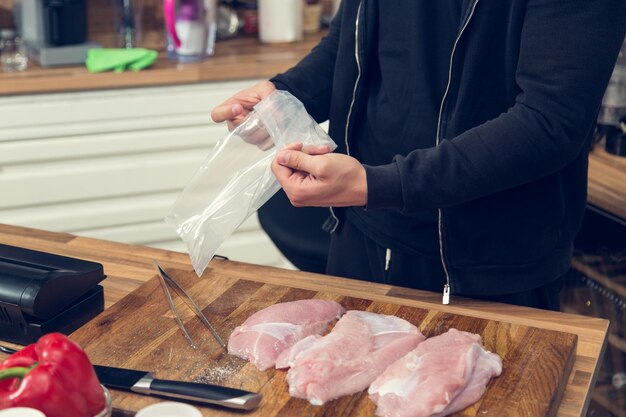
| Fresh meat for freezing | Moist mode or extended seal; pre-chill meat | Firm, tight bag with a slightly wider seal, minimal liquid near the top | Sealing with meat warm, causing steam and weak seals |
| Cheese blocks | Dry mode, gentle or pulse if available | Cheese holds shape, bag snug but not crushed | Over-vacuuming soft cheese until it deforms or oozes |
| Delicate items (berries, crackers) | Pulse vacuum or gentle mode, stop when just snug | Food still looks whole; slight movement possible in bag | Letting full vacuum run, turning berries to jam or crackers to crumbs |
| Soups and sauces (for freezing) | Freeze flat in container first, then vacuum in bag | Solid block inside bag, no liquid in vacuum channel | Trying to vacuum seal liquid while it’s still pourable |
| Marinating meat | Short vacuum cycle or container mode with accessories | Bag draws in, marinade covers meat evenly | Too long vacuum on very thin bags, leading to small punctures |
| Resealing snack bags (chips, nuts) | Seal-only, no vacuum | Neat new seal line across trimmed edge | Vacuuming chips and ending up with “seasoned dust” |
Cleaning and maintenance that doesn’t ruin parts
After each use
- Unplug the Vacuum Sealer and let the sealing strip cool for a few minutes.
- Wipe the vacuum channel, sealing strip area, and lid underside with a soft damp cloth.
- Empty and wash the drip tray in warm soapy water; dry fully before putting it back.
- Check for bits of food or plastic in the gasket and gently remove them.
Roughly once a week during heavy use
- Give the exterior a wipe-down to remove dust and grease.
- Inspect the gasket for cracks, flattening, or stickiness; clean with a damp cloth.
- Check the power cord for kinks or damage and make sure it is not pinched behind cabinets.
- If your Vacuum Sealer has an accessory port, wipe around the port and hose connections.
When it smells off or performance drops
- Remove the drip tray and soak it in warm soapy water; rinse and dry thoroughly.
- Clean the vacuum channel more carefully to remove any dried juices or crumbs.
- Wipe the sealing bar gently; do not scrape it with metal tools or abrasives.
- Leave the lid open for an hour or so to air out any lingering odors.
What not to do
- Do not use steel wool, scouring pads, or abrasive powders on the sealing strip, lid, or housing.
- Do not pour water directly into the vacuum channel or over the control panel.
- Do not bend or pull on the gasket; it needs to sit evenly to maintain a seal.
- Do not run continuous sealing cycles without short breaks; heat buildup can warp the sealing strip.
Quick maintenance checks for common complaints
If your Vacuum Sealer suddenly seems weaker or seals poorly, check these areas.
- Weak vacuum / lots of air left in bag
- Make sure the lid is fully latched on both sides.
- Wipe the gasket and vacuum channel; even a small crumb can break the seal.
- Check for cracks or flattening in the gasket and that the bag is not folded over in the channel.
- Seal line looks thin or incomplete
- Let the unit rest to cool, then try again; overheating can reduce seal quality.
- Use bags designed for Vacuum Sealer use; very thick or very thin plastics seal poorly.
- Ensure the bag mouth is clean and dry before sealing.
Troubleshooting that gets you unstuck fast
Quick decision path when it will not start
- Check that the power plug is fully inserted into a working outlet.
- Confirm the lid is closed and latched; many Vacuum Sealer models will not run with a partly open lid.
- Press cancel, then select your mode again in case a previous cycle was interrupted.
- Let the unit cool for about 15–20 minutes if you have just done many seals in a row.
- If there is still no response, stop using it and consider professional service.
Symptom → likely cause → fix
| Symptom | Likely cause | Suggested fix |
|---|---|---|
| Bag still has visible air pockets after vacuum | Lid not fully latched or gasket not sealing | Press firmly on the lid while starting the cycle; clean the gasket and try again. |
| Seal line looks patchy or broken | Wrinkles, moisture, or food in the seal area | Trim bag, dry the opening, lay it flat, and run a seal-only cycle. |
| Vacuum Sealer runs, but suction is weak | Gasket worn, dirty, or dislodged | Clean and check the gasket for damage; reseat it if removable. |
| Unit suddenly stops mid-cycle | Overheating protection or power interruption | Unplug, let it cool for about 20 minutes, then plug back in and test with an empty bag. |
| Lid is difficult to close or open | Food debris in latch area or vacuum still present | Gently press release buttons if present; clean hinges and latches with a damp cloth. |
| Loud new noise from pump | Loose bag end, liquid or crumbs entering the channel | Stop immediately, clean the vacuum channel and drip tray, and try again with a clean, dry bag end. |
| Bag melts, warps, or sticks excessively | Bag material not suitable or sealing bar too hot from repeated use | Use proper Vacuum Sealer bags; allow a few minutes between seals. |
| Sealed bags lose vacuum over time in freezer | Small punctures from bones or sharp edges | Pad sharp bones with a small piece of folded bag or parchment at the contact point before sealing. |
| Liquid is sucked into the unit | Food too wet or not pre-frozen | Stop use, clean drip tray and channel thoroughly, and next time pre-chill or freeze liquids before sealing. |
| Accessory hose mode not working | Loose hose connection or container lid not aligned | Press hose firmly into the accessory port and make sure container lid valves are in the correct position. |
When your Vacuum Sealer keeps losing vacuum
- Inspect the bag for tiny holes, especially where bones or sharp pasta ends poke outward.
- Check that the seal is at least 2–3 mm wide and smooth across the entire width.
- Try making a second seal band a short distance above the first for extra security.
- If failures continue across multiple bags, inspect the gasket and sealing strip for damage or unevenness.
When to stop and get service
- The Vacuum Sealer will not power on after you have confirmed the outlet works with another appliance.
- You see visible cracks, deformation, or burns on the sealing strip or internal plastic near the heating area.
- The pump makes a grinding or harsh mechanical noise even with no bag present.
- The unit emits a persistent burning or electrical smell that does not disappear after cooling and cleaning.
- The housing or power cord is damaged, cut, or feels loose at the plug connection.
- Liquid has been drawn far inside the unit beyond the drip tray area.
Smart habits that save time
- Keep a pen or marker next to your Vacuum Sealer so you always date and label bags before they go into storage.
- Store bag rolls and spare bags in a dry drawer near the unit to avoid hunting for them every time.
- Pre-freeze items like meatballs, berries, and cut fruit on a tray, then transfer to Vacuum Sealer bags for neat, stackable packs.
- Create “dedicated bag lengths” for things you seal regularly, like standard chicken breast portions or blocks of cheese.
- If your kitchen is small, coil the cord loosely and store the Vacuum Sealer in a cabinet with enough height to avoid straining the cord.
- Use accessory containers for foods you open frequently, like coffee or nuts, to avoid resealing bags every few days.
Used wisely, your Vacuum Sealer can reduce food waste, make freezer storage tidy, and cut weeknight prep time.
Quick FAQ
Can I reuse Vacuum Sealer bags?
You can often reuse bags that previously held dry, non-greasy foods by cutting off the old seal and washing the remaining portion. Avoid reusing bags that held raw meat, fish, or oily foods, since residues are hard to remove.
Why does my Vacuum Sealer need special bags?
Vacuum Sealer bags usually have a textured or channeled side that lets air escape evenly. Regular smooth plastic bags trap air, seal poorly, and can melt at the sealing strip.
How much empty space should I leave at the top of the bag?
Leaving about 5–7 cm of space above the food gives enough room for the bag to flatten and seal without bunching or spilling into the vacuum channel.
Is it safe to vacuum seal warm food?
Allow food to cool to room temperature before vacuum sealing. Sealing hot or steaming food can trap moisture, affect seal strength, and increase condensation inside the bag.
Can I use my Vacuum Sealer for non-food items?
Yes, many people vacuum seal items like documents, matches, or camping supplies to keep them dry. Just avoid sealing anything with sharp edges that will puncture the bag.
Why do some bags puff up again in the freezer?
This usually means the seal was incomplete or the bag was punctured. Check the seal line, pad sharp bones or corners before sealing, and double-seal if storing long term.
How long should I let the unit rest between seals?
After several continuous seals, let the Vacuum Sealer rest for about 1–3 minutes so the sealing strip can cool slightly. This helps prevent overheated, weak, or melted seals.
Is vacuum sealing a replacement for refrigeration?
No. Vacuum sealing slows spoilage but does not make food shelf-stable by itself. Keep perishable foods in the refrigerator or freezer even after vacuum sealing.
Can I vacuum seal liquids directly?
For best results, freeze liquids like soup or stock in a separate container first, then transfer the frozen block into a bag and seal. This protects the pump and keeps seals clean.
What’s the benefit of a pulse or gentle mode?
Pulse and gentle modes help you stop the vacuum when the bag is just snug, which is useful for delicate foods or items that crush easily.
Why does my Vacuum Sealer make a hissing sound at the end?
A short hiss near the end of the cycle can be the internal valve releasing pressure as it switches from vacuuming to sealing. If the sound is long and continuous with poor vacuum, check the gasket and lid closure.
With these tips, your Vacuum Sealer is not mad at you—it just needed a little understanding. Now it can get back to quietly protecting your food from freezer burn while you tackle the rest of your day.
Discover More
- Air Conditioner
- Air Fryer
- Air Purifier
- Automatic Soap Dispenser
- Barbecue Grill
- Beverage Cooler
- Beverage Dispenser
- Beverage Fridge
- Blender
- Boiler
- Bread Maker
- Bread Slicer
- Bread Toaster Oven
- Can Opener
- Carpet Cleaner
- Ceiling Fan
- Ceiling Heater
- Ceiling Mounted Heater
- Ceiling Mounted Vent Fan
- Central Vacuum
- Charcoal Grill
- Citrus Juicer
- Clothes Dryer
- Clothes Steamer
- Coffee Grinder
